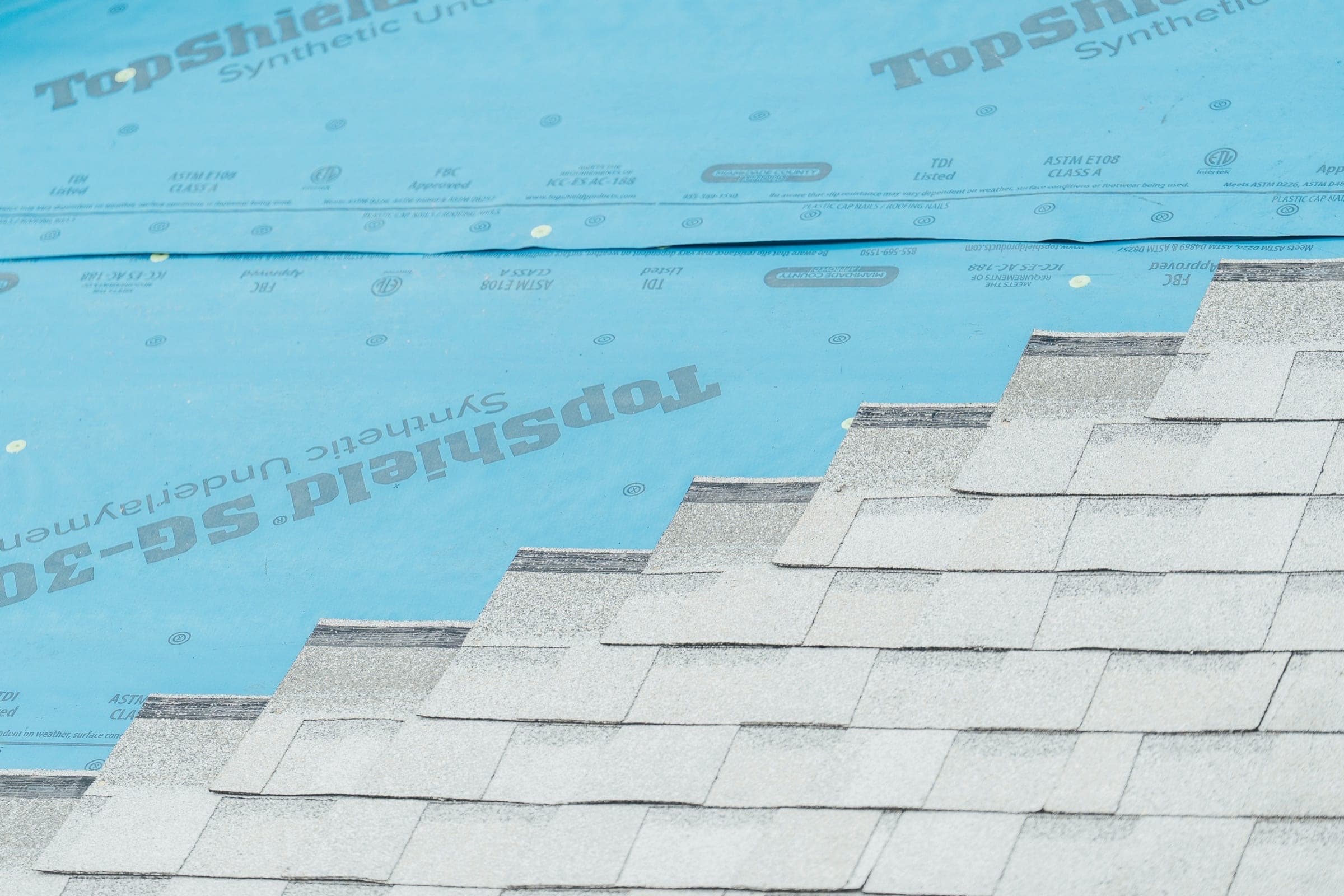
After receiving two roofing quotes, one quote lists synthetic underlayment and another lists felt. What is the difference? Both do the same basic job. They form a water-shedding layer between the wood roof deck and the shingles. The differences show up in what the sheet is made of, how it handles moisture, and what the shingle manufacturer’s instructions call for on your roof’s slope.
What underlayment does
Underlayment is the backup layer under your shingles. IKO’s guide to roofing felt (opens in a new tab) explains that it helps water drain off the roof when wind-driven rain or snow gets under the shingles. It protects the deck if a storm tears shingles loose, and it gives the shingles a smoother surface to sit on when the deck is not perfectly flat. IKO says a roof with asphalt shingles should be fully covered with at least one layer.
Underlayment is not the same as ice-and-water shield. This self-adhered membrane goes at the eaves, valleys, and openings, and regular underlayment covers the rest of the deck. The ice-and-water shield guide explains its placement.
How felt and synthetic differ
Felt and synthetic underlayment
| Question | Felt | Synthetic |
|---|---|---|
| What it is | A base of wood cellulose, fiberglass, or polyester saturated or coated with asphalt | A manufactured synthetic sheet; Owens Corning’s instructions reference the ASTM D8257 standard for synthetic underlayment |
| Common grades | No. 15 and No. 30, named for old weights per 100 square feet | Specs vary by product; the product data sheet lists them |
| Moisture | Sheds water while still letting the material breathe, per IKO | Lower moisture permeability than felt, per IKO |
| Fastening | Nails or staples, per product instructions, per IKO | Some synthetics have a self-adhesive back, per IKO |
Felt has a long track record. IKO notes that NRCA has included roofing felt in its recommendations for more than 25 years. NRCA’s homeowner resources (opens in a new tab) suggest No. 30 felt instead of No. 15 when you are installing a heavier shingle with a long expected service life.
How roof slope changes the layers
The shallower the roof, the more layers the instructions usually call for, whichever material is used.
- Felt. NRCA recommends one layer of No. 15 felt on asphalt shingle roofs with slopes of 18 degrees (roughly a 4:12 pitch) or more, and at least two layers on slopes between 14 and 18 degrees (roughly 3:12 to 4:12).
- Synthetic. Owens Corning’s installation instructions (opens in a new tab) for its Duration STORM and FLEX shingles call for synthetic underlayment on standard slopes of 4:12 and steeper. On low slopes from 2:12 to less than 4:12, they call for either two overlapped layers of synthetic underlayment or a self-adhered ice-and-water barrier.
Every shingle line has its own instructions, and local code can add requirements. The details on your roof should follow the product your contractor is installing. If part of your house has a shallow porch or addition, the low-slope roof guide covers what changes there.
What happens if it rains before the shingles go on
Usually the underlayment can stay, as long as it is in good shape. NRCA says an underlayment can be left without a roof covering for some time, and that its condition matters more than how long it has been exposed. If rain wrinkles it, NRCA suggests that it can stay in place as long as the wrinkles are not bad enough to affect the shingle installation. IKO adds that shingles should not go over felt that has frost or snow on it, and the underlayment has to be completely dry. Our guide to roof replacement in cold or rainy weather covers how weather changes the schedule.
How to compare quotes
A line that says only “underlayment” or “synthetic felt” leaves out details that can differ between bids. When you compare quotes, it can help to ask:
- Which product will be installed, and is it approved for the shingles on the quote?
- Is it one layer or two, and on which parts of the roof?
- Where does the separate ice-and-water shield go?
- Which ASTM or CSA standard does the product meet? IKO suggests checking the product label for these references.
How Remi handles underlayment
If you are comparing a Remi quote, the underlayment question has a short answer. Every Remi roof includes synthetic underlayment (shingle FAQ). We use synthetic underlayment as part of our roofing system. Remi offers a clear, itemized quote, so the underlayment shows up as its own line rather than being folded into a total.
He came prepared with our estimate before we even started chatting and was transparent about all pricing options.
Tyler describes one estimate conversation. Confirm the product specifications and price in your own written quote.
For more on what a full quote should list, see the roof estimate guide.
Synthetic underlayment is standard
Get a roof quote
Comparing bids? A Remi quote gives you one more to line up against the others.
Questions homeowners ask
Not without removing shingles. If you would like a record of what went down, you can ask your contractor whether photos can be taken before the shingles cover it.
No. NRCA says a double layer of No. 15 overlaps each sheet by 19 inches, while a single layer overlaps by 2 inches. The two are installed differently.
Sources and further reading
- IKO: The Purpose of Roofing Felt (opens in a new tab) (checked 2026-10-25)
- National Roofing Contractors Association: NRCA Resources (opens in a new tab) (checked 2026-10-25)
- Owens Corning: TruDefinition Duration STORM and TruDefinition Duration FLEX Shingles Installation Instructions (opens in a new tab) (checked 2026-10-25)
Product instructions, warranty terms and local requirements can change; use the documents that apply to your project.