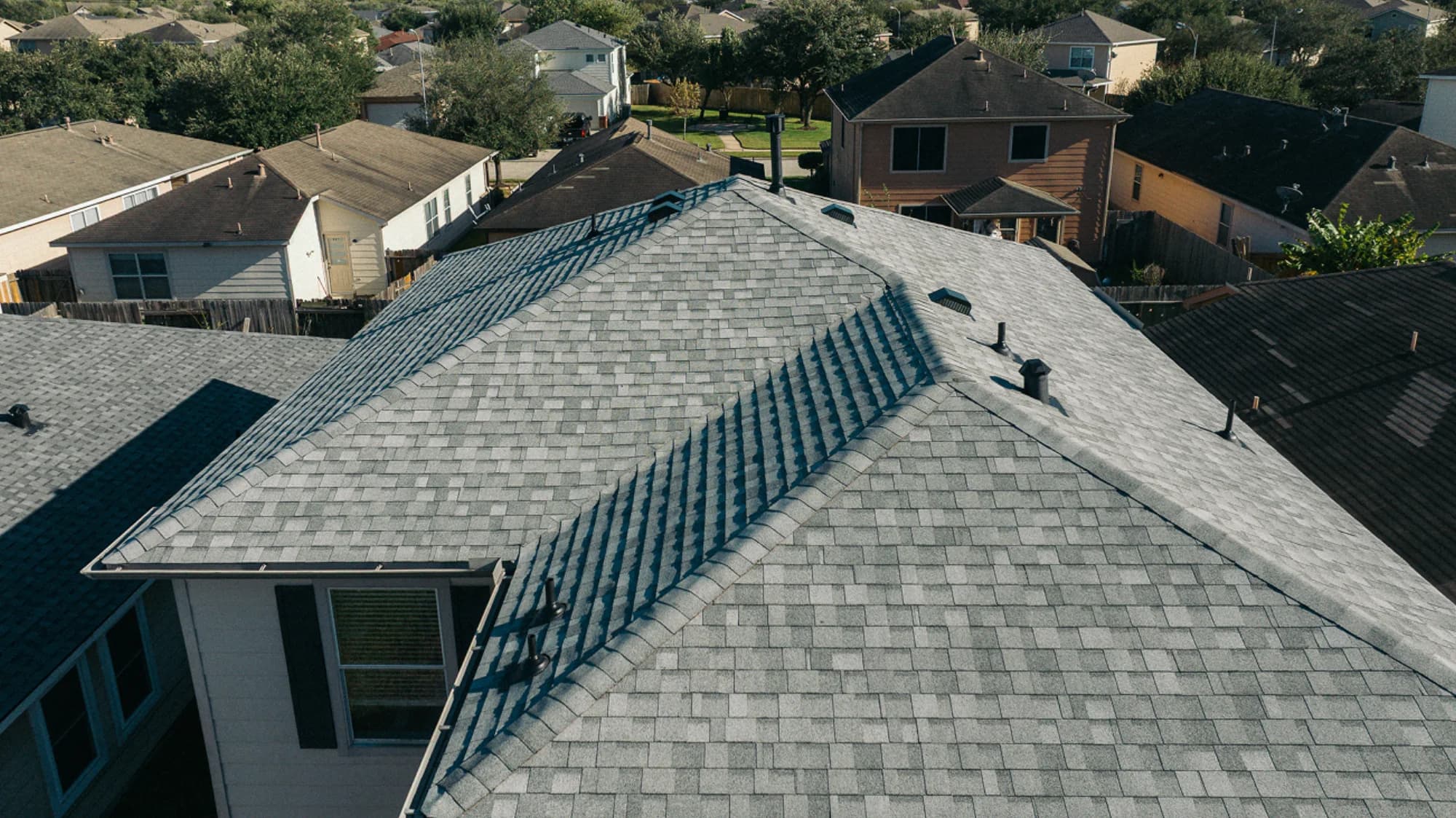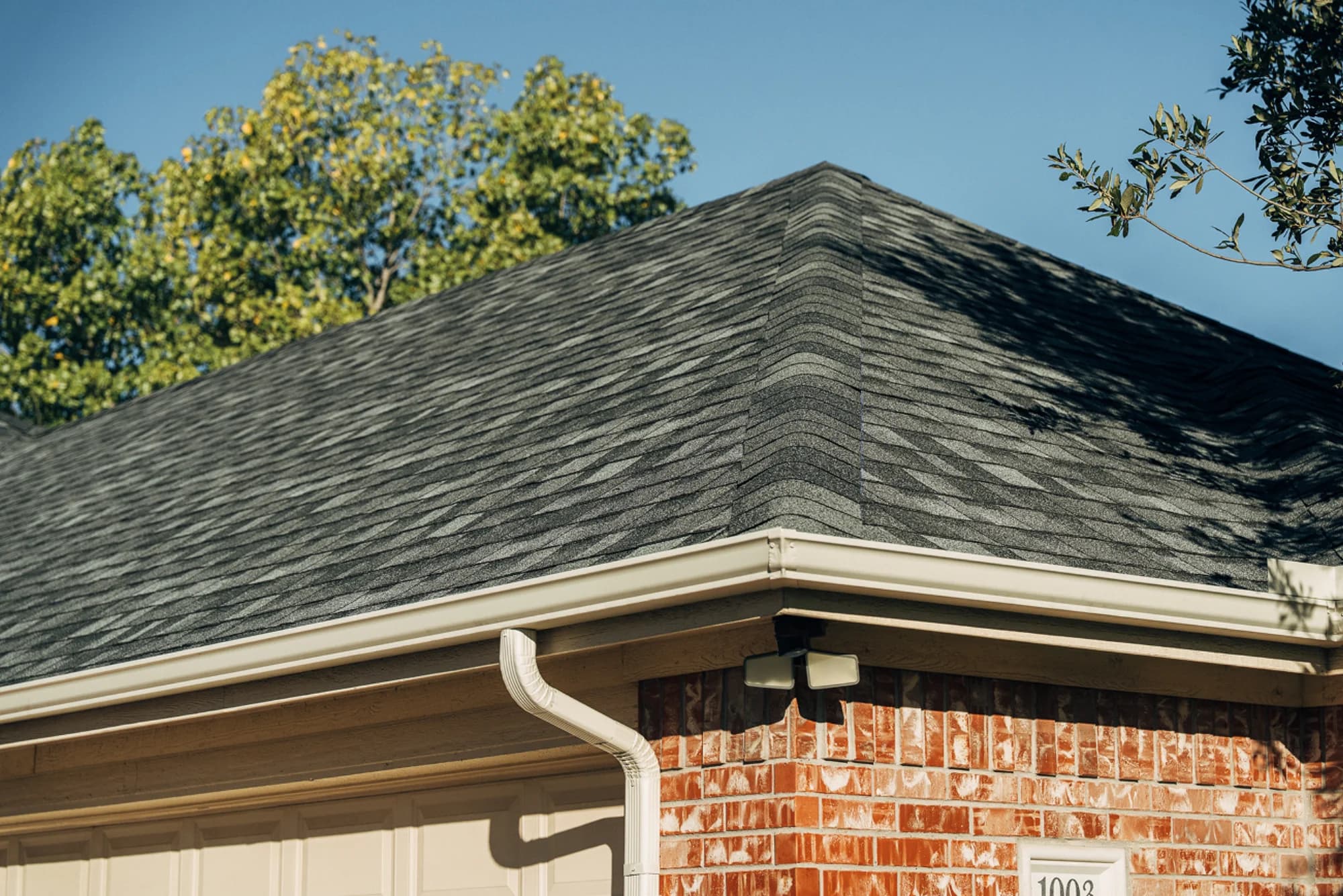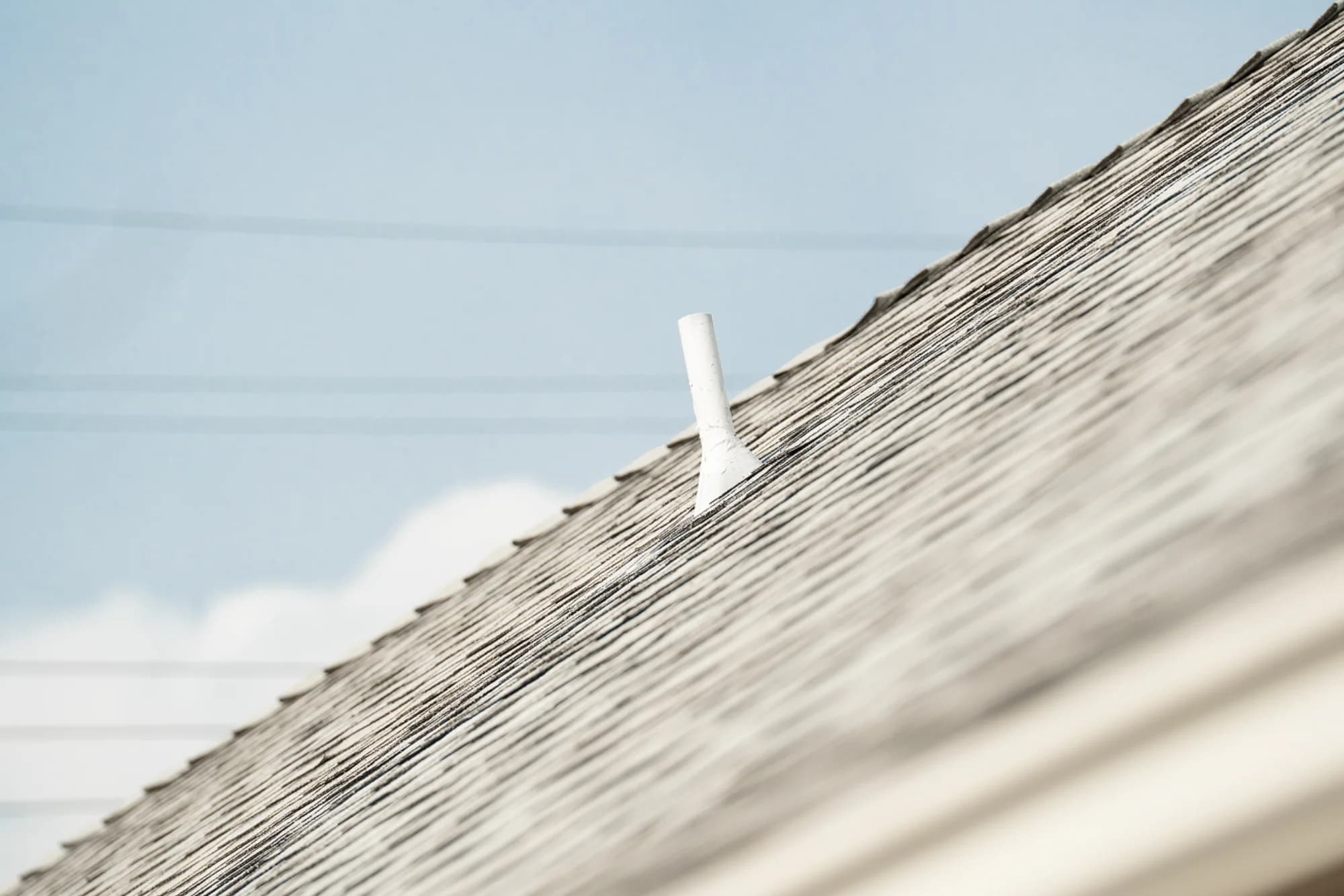
Hail damage on a shingle is a small, round, dark spot where the granules were knocked away, with a soft bruise underneath. From your driveway, you will rarely see this detail. But what you can see are the marks that hail left on everything around the shingles.
Start there, stay off the roof, and let an inspection settle what the shingles themselves show.
What can you see from the ground?
Metal keeps a record of hail that shingles hide. Walk the outside of the house and look for these signs:
- Dents in gutters, downspouts, and roof vents. Soft metal marks easily, so fresh round dents are often the first clue.
- Dented fins on the air conditioner. Scott Morrison, an engineer at Haag Engineering writing in Professional Roofing (opens in a new tab), the National Roofing Contractors Association’s magazine, calls these the best gauge of hailstone size, with a dent typically about 80 percent as wide as the stone.
- Spatter marks. These are clean spots on a fence, deck, or metal box where hail knocked away grime or oxidation. Morrison’s article says that they typically linger for about a year.
- Granules in the gutters and at the downspouts. Owens Corning lists loss of protective granules that collect in gutters and downspouts (opens in a new tab) among the signs to look for after a hailstorm.
- Shingle pieces or other roofing material in the yard.
- New ceiling stains or damp spots in the attic.
Photograph each one with the date, from the ground. Our 72-hour plan after hail covers what to do with those photos next.
The Insurance Institute for Business & Home Safety (IBHS), a nonprofit that tests how buildings hold up to hail, shows several of these signs in a 36-second video. Treat it as a guide to what to look for from the ground, not a reason to get on the roof.
What does hail do to an asphalt shingle?
It hits like a small hammer. The damage that matters is a fracture in the mat that holds the shingle together.
Engineers at Haag, a firm that inspects storm-damaged roofs, define functional hail damage to asphalt shingles as punctures, tears, or fractures in the shingle mat (opens in a new tab). They call the fractures bruises. A bruise is a spot where granules are missing and the shingle gives under a fingertip, much like a bruise on an apple. The fracture starts on the underside of the shingle and works upward, so a trained inspector can confirm it from the back.
Three more details help separate hail from everything else. Hail falls in a random pattern, so real hits are scattered, not lined up in rows. Shingles with little support beneath them are hit hardest, which means ridges, edges, eaves, and valleys. And color shows age: Haag notes that recently exposed asphalt looks black, while asphalt exposed for years has weathered to gray.
What gets mistaken for hail damage?
Plenty. Haag’s authors write that inspectors frequently mistake ordinary shingle conditions for hail.
- Blisters. Small raised bubbles, usually about a quarter inch across, that can break open and leave pits. They come from the shingle and the sun, not the storm.
- Foot traffic. Walking on warm shingles pushes granules aside and leaves scuffs.
- Age. Cupping, curling, splitting, and granules flaking away in patches are signs of an old shingle.
- Manufacturing and installation marks. Bands of thin granules, or dark round spots where adhesive dripped.
Granule loss alone is the hard case, and the sources do not fully agree. Haag’s 10-year exposure study concluded that shingles that lose some granules in a hailstorm are not damaged as long as they remain covered. Owens Corning says shingles that have lost granules have a higher risk of failing early. An inspector and your insurer will look for the bruise underneath, not the granules alone.
Does the size of the hail settle it?
No. Size is context. NOAA’s National Severe Storms Laboratory considers hail of 1 inch, about the size of a quarter (opens in a new tab), severe, and it estimates that stones of 1 to 1.75 inches fall at 25 to 40 miles per hour. Roof age, shingle type, and the angle of the hit all change the result. Our guide to reading a storm report explains what a hail report can and can’t prove about one house.
The same caution applies to the dents you find. Marks on metal show that hail fell and roughly how big it was. But they do not show that the roof was damaged. Morrison notes in the same article that a roof is not functionally damaged by hail unless its ability to shed water is diminished or its expected service life is reduced.
What does a Remi inspector document?
The things you cannot check from the ground, recorded so that someone else can verify them.
When Remi inspects a roof for a claim, Remi’s certified team documents everything with photos and measurements, as described on our page for insurance carriers. Our storm damage roof inspection guide covers what that inspection includes and how it differs from a price quote.
An assessment should also separate what the storm did from what age did, slope by slope. This distinction is the one an adjuster has to make.
In a video review, one Remi customer described what the inspection turned up:
There was quite a bit of wind damage, but then the assessor for Remi found a lot of hail damage that I wasn't aware of.
Dianne’s experience describes one roof. A professional inspection can document roof conditions, but only the insurer determines whether a loss is covered.
Remi documents the roof and prepares the roofing scope and price. Your insurer decides whether the damage is covered. Our guide to who is involved in a roof insurance claim lays out each role.
Frequently asked questions
Yes. Bruised shingles often look normal from the driveway. That is why dents on metal are a reason to ask for an inspection, not a reason to assume the roof is fine or ruined.
No. Stay off a roof after a storm. Wet or damaged shingles are a fall risk, and walking on them can leave marks of its own.
Soon. Your policy sets the notice requirements for a claim, and evidence such as spatter marks fades. Write down the storm date, take photos, and ask your insurer what deadline applies.
Your next step
Walk the house with your phone and photograph the gutters, downspouts, vents, air conditioner, and anything that fell into the yard. Note the storm date. Then request a roof quote and say a storm is involved. Remi sends an inspector to document the roof when you file an insurance claim.
Sources
- 01Hail Damage to Asphalt Roof Shingles (opens in a new tab), Haag Engineering (Timothy P. Marshall and others). Accessed 2026-10-13.
- 02Holy hail! Learn how to identify hail damage on roof systems (Scott J. Morrison, P.E., Haag Engineering) (opens in a new tab), Professional Roofing, National Roofing Contractors Association. Accessed 2026-10-13.
- 03Roof Hail Damage (opens in a new tab), Owens Corning. Accessed 2026-10-13.
- 04Severe Weather 101: Hail Basics (opens in a new tab), NOAA National Severe Storms Laboratory. Accessed 2026-10-13.
- 05Can you spot hail damage? (opens in a new tab), Insurance Institute for Business & Home Safety. Accessed 2026-10-13.