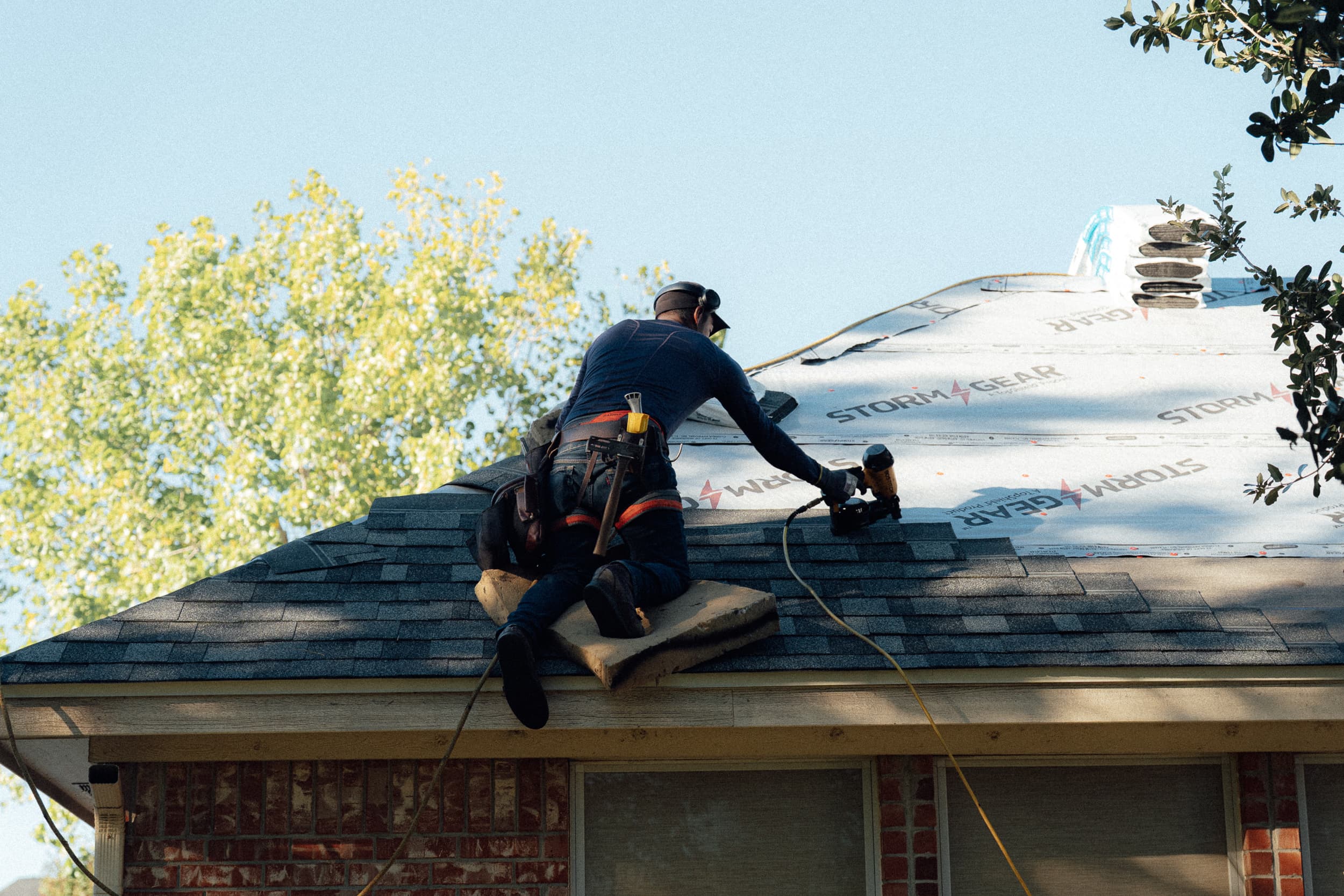
Recoverable depreciation is the part of a roof claim your insurer holds back at the start and pays later, once you show proof of the repair work. If your first check looked small next to the roofing quote, recoverable depreciation, along with your deductible, is usually the reason.
Recoverable depreciation only exists on replacement cost coverage. The insurer pays the roof’s depreciated value first, then pays back the depreciation once you show proof of the work.
How does recoverable depreciation work on a roof claim?
A replacement cost claim is usually paid in two checks. The Texas Department of Insurance (TDI) describes the first check in its home insurance guide (opens in a new tab). It is for the estimated cost of repairs, minus depreciation and your deductible.
Depreciation, in TDI’s words, is an amount subtracted for wear and tear or age.
The second check is the depreciation coming back. TDI says the insurer pays the amount it kept for depreciation after it gets the bill for the finished job.
Say an insurer estimates a roof replacement at $18,000, subtracts $6,000 for depreciation, and applies a $2,000 deductible. The first check would be $10,000. After the roof is replaced and the insurer has what it asked for, it would consider the $6,000 it held. The $2,000 deductible stays with you from start to finish. Our guide to “zero out-of-pocket” roof offers explains why many states bar roofers from covering it.
What is the difference between recoverable and non-recoverable depreciation?
Recoverable depreciation is paid back after the work. Non-recoverable depreciation is not.
The difference comes from the policy coverage on your roof. With replacement cost coverage, the National Association of Insurance Commissioners (NAIC) explains, the policy pays to repair or replace the roof without deducting for depreciation (opens in a new tab) in the end. With actual cash value coverage, the policy pays the depreciated cost and stops there. Our guide to getting insurance to pay for a roof replacement explains how each coverage type changes the payment.
A single claim can contain both recoverable and non-recoverable depreciation. Some policies cover the house at replacement cost and the roof at actual cash value, and TDI notes that some companies switch the roof to actual cash value as it ages (opens in a new tab). That’s why the two numbers are worth asking for separately, and we ask for both. On a claim referred by an adjuster, we ask for the deductible and for the depreciation, both recoverable and non-recoverable, before we write the estimate. You can read the full list on our page for insurance carriers.
What releases the second check?
When the second check arrives depends on the insurer. TDI’s home insurance guide (opens in a new tab) ties it to the bill for the finished job, while its disaster claims FAQ (opens in a new tab) says the insurer sends the remainder once you’ve started repairs and show proof to your company.
Ask your adjuster which applies to your claim.
Insurers do not all ask for the same proof. Some common requests include a final invoice, photographs of the completed roof, and the result of any required permit inspection. Ask your adjuster for the list in writing before the work starts, so that nothing has to be recreated afterward.
Most of that proof comes from the roofer, and a Remi project produces it as part of closing out the job:
- Completion photographs. The crew uploads photos when the work is done, and Remi reviews them before the crew is paid.
- Inspection results. Any required permit or final inspection has to be passed.
- Closeout paperwork. Where it applies, closeout includes a walkthrough or homeowner confirmation and the final invoice.
- Warranty documents. Every Remi roof includes a 5-year workmanship warranty and a manufacturer’s materials warranty. Your signed warranty documents explain the coverage and exclusions.
Remi’s About page describes the scope of that responsibility: “Now Remi owns the roofing project from the first inspection all the way to the certificate of completion.”
One homeowner described the updates through to completion this way:
From the moment of my first phone call to the day of completion, I was contacted by Remi with the status of my work order.
That describes one project. Ask your adjuster which completion records your insurer needs before it releases the second check.
Remi provides the records. Your insurer decides whether they satisfy the policy and when the payment goes out.
Is there a deadline to claim it?
Usually, yes, and it comes from your policy. TDI’s guide says that you usually must complete repairs within a certain period of time
and tells homeowners to ask their agent or adjuster how long they have.
Get that date in writing early. A roof that waits on permits, materials, solar coordination, or weather can use up more of the window than you expect. To see where those weeks tend to go, read How Long Does an Insurance Roof Replacement Take?
Who gets the recoverable depreciation check?
The second check follows the same path as the first check, and that path may not lead straight to you.
If you have a mortgage, the insurer will often name the lender on the check. The Consumer Financial Protection Bureau says home insurers generally pay with a check made out to both you and your mortgage servicer (opens in a new tab), and that the servicer typically releases the money in stages as the work progresses. In Texas, TDI’s home insurance guide (opens in a new tab) says a mortgage company must release all or some of the money within 10 days of getting the information it asked for. Other states set their own rules. Be sure to call your servicer when the claim opens, and avoid waiting until the second check arrives.
The check can also go to the roofer. On a claim an insurer assigns to Remi in full, we bill the carrier once you’ve signed a Direction to Pay. That form lets the carrier pay us directly for the approved work. If the insurer has already released funds to you, we collect the approved amount from you instead.
Either way, the money is part of the claim payment for the finished roof; it is not a separate amount on top of it.
Where Remi fits
Remi does not decide what your policy pays, calculate your depreciation, or act as a public adjuster. For what each role covers, read Who Is Involved in a Roof Insurance Claim?
On the roofing side, Remi gives you a written scope and quote. When that quote has a guaranteed price, the price we quote is the price you pay. Projects quoted under special discounts or promotions may not be eligible. The guarantee doesn’t cover new structural decking where none exists or elective fascia upgrades beyond code requirements. A fixed price makes the claim arithmetic easier to follow, because the roofing number does not move while you wait on the insurance numbers.
Frequently asked questions
No. Actual cash value coverage pays the depreciated amount and does not pay the depreciation back. Check whether your roof is covered at replacement cost or actual cash value, because the roof can differ from the rest of the house.
Ask your adjuster how the final payment is calculated in each case before you sign a roofing contract. There is no single rule; the answer depends on your policy.
It depends on how the project is paid. On a claim the insurer assigns to Remi in full, the carrier can pay Remi directly once you sign a Direction to Pay. When a project uses PayKeeper, the escrow service on Remi’s payment page, it holds the funds and releases them to Remi as milestones are completed and verified. Qualified homeowners who finance have $0 due at signing. Ask for your payment schedule in writing before you sign, and compare it with the dates your insurer gave you.
Do not assume so. TDI’s guidance ties the payment to proof of the repair work. Send the documents your adjuster listed, then ask for written confirmation that the file is complete.
Your next step
Ask your adjuster three questions in writing: how much depreciation is recoverable, what proof releases it, and the date the work must be finished by. Then request a roof quote so that you have a written scope and price to plan around.
Sources
- 01Home insurance guide (opens in a new tab), Texas Department of Insurance. Accessed 2026-10-12.
- 02FAQ: Homeowners insurance and disaster claims (opens in a new tab), Texas Department of Insurance. Accessed 2026-10-13.
- 03Insurance and your roof: What to know when buying a policy or filing a claim (opens in a new tab), Texas Department of Insurance. Accessed 2026-10-12.
- 04Consumer Insight: replacement cost versus actual cash value for your roof (opens in a new tab), National Association of Insurance Commissioners. Accessed 2026-10-12.
- 05How do home insurance companies pay out claims? (opens in a new tab), Consumer Financial Protection Bureau. Accessed 2026-10-13.